Posts

Think you’ll lose your job to AI? No, you’re being promoted!

Image
Contrary to dystopian narratives, artificial intelligence (AI) isn't here to take our jobs. Rather, it is turning us all into managers. And your success in the AI age depends on whether you are willing to step into that new role. The current AI discourse paints a bleak picture of mass unemployment and identity crises, as AI surpasses our abilities as humans. I disagree. Historically, technological transformations have always yielded a net gain in jobs, albeit amidst disruptive periods and the extinction of certain professions. I don’t see a reason why AI should deviate from this trend, even when accounting for its unprecedented pace of change. Far from making you less useful or worthy, AI is not replacing you or diminishing the value you bring to the table. On the contrary, AI, like any other technology before, gives you powers you didn't have before. It enhances your existing skills and allows you to do the things you already do – but faster, with higher quality and with bigge...

Discussing ChatGPT with the World Bank: Questions on research, knowledge management, bias and creativity

Image
      (Illustrative Image generated with Midjourney) On May 3, 2023, I had the pleasure to talk to the World Bank Group's Community of Practice on Knowledge Management about the opportunities that ChatGPT and similar tools present to the KM space. The group was exceptionally astute and came up with a number of very important questions that I believe are critical to reflect on. In the following, I am showcasing a few of them, along with my own thoughts that I articulated in the exchange: Question 1: I am interested to know if systems like ChatGPT can generate valuable new knowledge, i.e. combine lessons from a few past projects and suggest how should we approach the upcoming project? Generative models like GPT-4 will always build on existing bodies of knowledge, and therefore are (at the moment at least) better suited for a look into the past than as a tool for foresight or predictive analysis. However, as you suggest, we can ask it to combine information, theories, framew...

Artificial Intelligence For Everyone Has Arrived! What Does That Mean For Knowledge Management?

Image
Anyone who has been following the discussions in Internet tech forums this week gets the unmistakable feeling that we are currently experiencing a qualitative transition, from a yesterday in which artificial intelligence (AI) was either a thing of the future or worked in secret behind specialized systems (Google Auto-Complete or error-prone Tesla Autopilots), and a today in which the technology is suddenly available to all Internet users at the push of a button for a wide variety of tasks and queries. Change happens, as Hemingway put it, "first gradually, then suddenly." We are experiencing just such a sudden moment. But why am I writing this here in a knowledge management column? Let's first take a step back: What is knowledge management fundamentally about? Knowledge should be collected, managed and used within an organization. And users within this organization should be able to access relevant knowledge and information quickly and easily. All with the goal of facil...

Going Back to Dave Snowden’s Seven KM Principles

Image
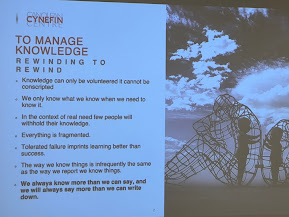
In June this year I attended the International Conference on Knowledge Management (ICKM) 2022 which conveniently took place in Potsdam, right around the corner of my current home base Berlin. One of the highlights was the key note speech of David Snowden . David is of course always a treat to listen to, but in his speech intro, he once again summarized so succinctly some of the key aspects of what KM is all about, that I wanted to re-state them for myself. So here are his gold nuggets: 1. Knowledge can only be volunteered, it cannot be conscripted The sharing of knowledge is inherently a human behavior. Yet it only happens when we are intrinsically invested in the positive impact that the sharing of our knowledge has on the receiving end (because we want to help, because we get nice feedback, because we want to build relationship, because it might help ourselves in the future, etc.). If we are told by someone else that we must share a particular knowledge, there is automatically a...

What Is Integral Knowledge Management And Why Do We Need It?

Image
Why do organizations struggle to consistently achieve results in knowledge management (KM)? Every employee in an organization can testify to the various pain points that KM is supposed to address in organizations, and they usually acknowledge the helpfulness of some individual tools and methods, but almost all organizations struggle to put them into a coherent conceptual framework that explains when and why KM as a whole succeeds in an organization, and when and why it doesn’t. I suspect that one of the key reasons for this might be the failure to adapt the type of KM approach to the values and work conditions of the organizations it is applied in, as well as the values and life conditions of the workers that are the target of the KM initiatives. Whenever we ask someone in an organization what KM is really about, we get invariably different responses. Some will emphasize the structured organization of existing documents and information, the next one will highlight mandatory business ...

Why Bitcoin is Integral Money

By Johannes Schunter What makes something integral? The term ‘integral’ refers to a worldview in the Spiral Dynamics (SD) model (developed by Don Beck, Chris Cowan and Ken Wilber based on the work of Clare Graves) that looks at various historic ways of seeing the world as each holding an important piece of the puzzle without being sufficient on their own. The hero worldview thinks primarily in heroic win/lose power relations, the absolutistic worldview champions collective rules and absolute truth, the modern worldview pursues rational science, competition and personal success, and the post-modern worldview values community, global diversity and inclusion. An integral mindset then tries to integrate the strengths from each of these worldviews into an overarching and balanced whole. To learn more about what the Spiral Dynamics model is about, this website is a good start . In the following, I argue that as far as monetary technologies, financial assets or currencies are concerned, B...