Posts

Seven guiding principles for knowledge management in your organization

As my organization is currently in the process of formulating a new Knowledge Management Strategy (replacing its past Knowledge Strategy 2009-2011 ), I recently found myself discussing a lot with colleagues within and outside the organization on what should be key principles or guiding points for knowledge management. I was particularly inspired by colleagues from IFAD which is currently also writing a KM framework, and I found lot of elements that seem to be quite universal across organizations. It seems that regardless of the strategic direction a specific organization might take, and regardless of how KM might relate to their organizational goals, there are a number of principles that ring true to KM practitioners all around. I am listing them here, looking forward to hear whether others can relate: Most of an organization's knowledge is tacit, stored in the minds of its employees and consultants. Only a part of this tacit knowledge can be documented and made available in in...

Exit interviews, knowledge databases and other attempts to trap sun rays in a glass jar

This month, I was asked how organizations could introduce a standard process by which all colleagues leaving their job will be requested to document their knowledge, including tools and documents they developed, in a database, so it can be accessed and researched by all colleagues for further reference. I feel the notion of “capturing knowledge in databases” keeps coming up from time to time like a haunting ghost that you never really get rid of. It important to take it seriously, because it is often a reflection of a deeper misconception in organizations of how knowledge sharing dynamics work, and therefore what knowledge management can (and cannot) achieve. The truth is that exit interviews and so-called “knowledge databases” are probably among the worst tools one can turn to when choosing a knowledge management approach. To me they are akin to the attempt of trapping sun rays in a glass jar. Let’s look a bit closer at the dynamics that are at play: While exit interviews ...

A nice list to find myself on: The world's top 100 global influencers in knowledge management

Image
Very happy to find my name as #75 on the list of the world's top 100 global influencers in knowledge management ! Even nicer to see that I am joined (and in most cases precluded) by a lot of dear fellow colleagues from the international development sector, in particular from the KM4Dev network (the Twitter account of which is itself at position #27). Waving in particular to my UN colleagues  @ithorpe (#12),  @gaurisalokhe (#15),  @rsamii (#40) and  @johanlammers (#45), as well as other friends in the development community who feature prominently on the list and from the professional insights and colleagueship of which I benefit tremendously. The list has been compiled and published by the Mindtouch Blog , which frequently features lists of top influencers of different business areas based on a particular Twitter hashtag (in this case #KM). You can access the full list of the top 100 influencers for #KM here .

Ten PowerPoint Slides on Knowledge Management that Have Influenced Me (Part 2)

Image
To get to Part 1 of this blog post,  click here . Do you hate PowerPoint presentations? Well, you probably have endured a lot of gruesome slides throughout the course of your professional life. But despite the usual wisdom that PowerPoint slides for presentations should be avoided whenever possible, I actually think that some well-crafted slides presented in the right context can be a very good thing. In fact, there are a number of slides that had a very positive impact on me in my knowledge management career. I treasure them because they manage to bring complex concepts to the point and often communicate an entire lesson’s worth of insight just with one diagram, graph or image. Here’s a list of ten powerful slides on knowledge management that have influenced me, which I am posting in two parts ( for Part 1 click here ). See for yourself whether you can get some inspiration from them. 6. The Innovation Adoption Curve The innovation adoption curve by sociol...

Ten PowerPoint Slides on Knowledge Management that Have Influenced Me (Part 1)

Image
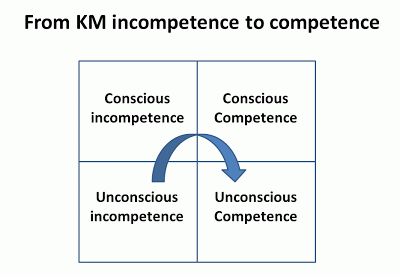
Do you hate PowerPoint presentations? Well, you probably have endured a lot of gruesome slides throughout the course of your professional life. But despite the usual wisdom that PowerPoint slides for presentations should be avoided whenever possible, I actually think that some well-crafted slides presented in the right context can be a very good thing. In fact, there are a number of slides that had a very positive impact on me in my knowledge management career. I treasure them because they manage to bring complex concepts to the point and often communicate an entire lesson’s worth of insight just with one diagram, graph or image. Here’s a list of ten powerful slides on knowledge management that have influenced me, which I am posting in two parts ( for Part 2 click here ). See for yourself whether you can get some inspiration from them. 1. From KM incompetence to competence © by Chris Collison and Geoff Parcell This graphic is taken from Chris Collison’s and Geoff Par...

The pitfalls of crowd-sourcing: We might not like what the crowd tells us

Image
I am excited to see more and more initiatives that tap into the wisdom of corporate or public crowds to shape priorities for specific policy agendas. Just recently, different units in my organization called on staff to submit ideas how to improve their business processes, and let all colleagues vote on them to determine which idea would get most traction and support. This is a great way to improve organizational efficiency while involving those affected by change in an actual change process. At the same time, the success of the Rio Dialogues showed how crowdsourcing policy recommendations and public voting on them can increase legitimacy of inter-governmental negotiations. This new model of public engagement during a United Nations summit received praise from participants as the “the most inclusive process in the history of global summits” (Josette Sheeran, VP of the World Economic Forum), and opened the door for similar approaches in defining the successors of the Millienn...

"New Synthesis" - A framework for generating solutions with citizens, rather than for them

This is the most terribly written book that every public administration practitioner should read. Well, I should rephrase that :-) This is a must-read for people working in public administration, but it takes a bit of suffering to get through it. Luckily I was helped by the fact that 340-pager was made available to our business unit for free, combined with a strong incentive by my boss to get familiar with its concepts as our unit prepares for aligning itself with its main message: That we as public administration practitioners “ are called upon to serve the public good and the collective interest in the face of increasing complexity, uncertainty and volatility ”. And only by shifting our strategies, systems and minds towards a framework that balances public policy with civic engagement as well as government authority with openness and collective power , are we able to face the challenges of public administration in the 21 st century. Developing a framework for public a...