Posts

Showing posts with the label principles

Going Back to Dave Snowden’s Seven KM Principles
Image
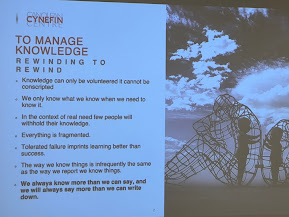
In June this year I attended the International Conference on Knowledge Management (ICKM) 2022 which conveniently took place in Potsdam, right around the corner of my current home base Berlin. One of the highlights was the key note speech of David Snowden . David is of course always a treat to listen to, but in his speech intro, he once again summarized so succinctly some of the key aspects of what KM is all about, that I wanted to re-state them for myself. So here are his gold nuggets: 1. Knowledge can only be volunteered, it cannot be conscripted The sharing of knowledge is inherently a human behavior. Yet it only happens when we are intrinsically invested in the positive impact that the sharing of our knowledge has on the receiving end (because we want to help, because we get nice feedback, because we want to build relationship, because it might help ourselves in the future, etc.). If we are told by someone else that we must share a particular knowledge, there is automatically a...

Seven guiding principles for knowledge management in your organization

As my organization is currently in the process of formulating a new Knowledge Management Strategy (replacing its past Knowledge Strategy 2009-2011 ), I recently found myself discussing a lot with colleagues within and outside the organization on what should be key principles or guiding points for knowledge management. I was particularly inspired by colleagues from IFAD which is currently also writing a KM framework, and I found lot of elements that seem to be quite universal across organizations. It seems that regardless of the strategic direction a specific organization might take, and regardless of how KM might relate to their organizational goals, there are a number of principles that ring true to KM practitioners all around. I am listing them here, looking forward to hear whether others can relate: Most of an organization's knowledge is tacit, stored in the minds of its employees and consultants. Only a part of this tacit knowledge can be documented and made available in in...