Posts

Showing posts with the label Knowledge Management

Thanks to AI, Explicit Knowledge Is About to Have Its Day in the Sun

Image
In knowledge management (KM), explicit knowledge – what’s written in documents and stored in files or other forms of media – has often had a bad reputation, and for good reason. Over years, KM has wrongly focused on documents and was busy building databases and repositories, when – as David Snowden put it – it shouldhave been focusing on connecting people instead . This preference is understandable. After all, explicit knowledge is just the tip of the iconic knowledge iceberg. Below the surface lies implicit knowledge, thoughts in people’s heads, rich with context and application insights, and accessible only through relationships and trust. However, I believe what we have been experiencing in 2023 with Generative AI marks a significant shift that could see explicit knowledge get its long-awaited moment in the sun. The Limitations of Content-focused KM and the Rise of AI Traditionally, KM never succeeded to fully leverage the knowledge that’s supposedly „stored“ in all the document...

Think you’ll lose your job to AI? No, you’re being promoted!

Image
Contrary to dystopian narratives, artificial intelligence (AI) isn't here to take our jobs. Rather, it is turning us all into managers. And your success in the AI age depends on whether you are willing to step into that new role. The current AI discourse paints a bleak picture of mass unemployment and identity crises, as AI surpasses our abilities as humans. I disagree. Historically, technological transformations have always yielded a net gain in jobs, albeit amidst disruptive periods and the extinction of certain professions. I don’t see a reason why AI should deviate from this trend, even when accounting for its unprecedented pace of change. Far from making you less useful or worthy, AI is not replacing you or diminishing the value you bring to the table. On the contrary, AI, like any other technology before, gives you powers you didn't have before. It enhances your existing skills and allows you to do the things you already do – but faster, with higher quality and with bigge...

Artificial Intelligence For Everyone Has Arrived! What Does That Mean For Knowledge Management?

Image
Anyone who has been following the discussions in Internet tech forums this week gets the unmistakable feeling that we are currently experiencing a qualitative transition, from a yesterday in which artificial intelligence (AI) was either a thing of the future or worked in secret behind specialized systems (Google Auto-Complete or error-prone Tesla Autopilots), and a today in which the technology is suddenly available to all Internet users at the push of a button for a wide variety of tasks and queries. Change happens, as Hemingway put it, "first gradually, then suddenly." We are experiencing just such a sudden moment. But why am I writing this here in a knowledge management column? Let's first take a step back: What is knowledge management fundamentally about? Knowledge should be collected, managed and used within an organization. And users within this organization should be able to access relevant knowledge and information quickly and easily. All with the goal of facil...

Going Back to Dave Snowden’s Seven KM Principles

Image
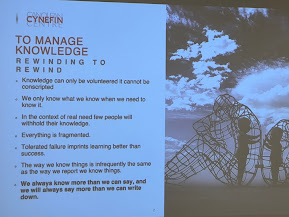
In June this year I attended the International Conference on Knowledge Management (ICKM) 2022 which conveniently took place in Potsdam, right around the corner of my current home base Berlin. One of the highlights was the key note speech of David Snowden . David is of course always a treat to listen to, but in his speech intro, he once again summarized so succinctly some of the key aspects of what KM is all about, that I wanted to re-state them for myself. So here are his gold nuggets: 1. Knowledge can only be volunteered, it cannot be conscripted The sharing of knowledge is inherently a human behavior. Yet it only happens when we are intrinsically invested in the positive impact that the sharing of our knowledge has on the receiving end (because we want to help, because we get nice feedback, because we want to build relationship, because it might help ourselves in the future, etc.). If we are told by someone else that we must share a particular knowledge, there is automatically a...

What Is Integral Knowledge Management And Why Do We Need It?

Image
Why do organizations struggle to consistently achieve results in knowledge management (KM)? Every employee in an organization can testify to the various pain points that KM is supposed to address in organizations, and they usually acknowledge the helpfulness of some individual tools and methods, but almost all organizations struggle to put them into a coherent conceptual framework that explains when and why KM as a whole succeeds in an organization, and when and why it doesn’t. I suspect that one of the key reasons for this might be the failure to adapt the type of KM approach to the values and work conditions of the organizations it is applied in, as well as the values and life conditions of the workers that are the target of the KM initiatives. Whenever we ask someone in an organization what KM is really about, we get invariably different responses. Some will emphasize the structured organization of existing documents and information, the next one will highlight mandatory business ...

Artificial Intelligence will change Knowledge Management as we know it

I recently came across this blog post by a start-up that is developing an Artificial Intelligence that is being trained to read and write at the level of a specialized human analyst and produce briefings in human language based on a set of different information resources. It’s just one example of many different companies that are currently working on this challenge. The obvious clients are intelligence agencies, governments, or news agencies, but eventually this will enter all of our everyday work very soon. I thoroughly believe that this is what knowledge management in large organizations will look like in 10-15 years from now. In my organization, we’re challenged daily to consolidate the key lessons and insights from all our country-level programmes and experiences, lest meaningfully combine them with information, trends and insights from the larger development sector. We complain that we’re overwhelmed by the information overload that social media, Yammer and knowledge network...

Who is Reading UNDP’s Publications, And Why?

Image
[This post was originally published at UNDP.org on Oct 3, 2016] It has been two years since the  World Bank published a report  that stated that over 30 percent of its policy reports have never been downloaded even once and only 13 percent of policy reports were downloaded at least 250 times. The debate among development practitioners that followed made it clear that the World Bank is by far not alone with this phenomenon and that most international organizations, including UNDP, face the exact same challenge. As UNDP provides support services for implementation of the Sustainable Development Goals (SDGs), we in UNDP’s Knowledge Management Team see the importance of getting insights into the perceived value of our knowledge products and therefore UNDP’s thought leadership in various SDG topics. In fact,  UNDP’s Knowledge Management Strategy 2014-2017  pointed out that UNDP needs to invest in its process of planning, developing and disseminating knowledge pro...

The “Duh-test”, or what is not a lesson learned

I was recently reviewing a number of texts which my organization collected from past projects and initiatives (some through an internal mandatory monitoring tool, others gathered as part of After Action Reviews or Lessons Learned Papers), which all meant to capture ‘lessons learned’ from specific experiences. And while these texts were not wrong per se, I realized that there seems to be a fundamental misconception what constitutes a good lesson, and what doesn’t. Here are a few typical examples of what we often collect as part of such lessons learned exercises: “Ensure that the [Team] Manager has excellent leadership, project and team management skills, understanding of programming and experience working in [the subject matter].” “Project outputs must be compatible towards project goals. Throughout the project there is a need for careful identification of project goals and outputs to ensure that they are compatible with each other. This can be only ensured through a consultativ...

What remains after the bonfire: How do we define success of an event?

Image
During the last few weeks I was heavily involved with the SHIFT Week of Innovation Action , a series of parallel events taking place in 21 different country offices. Over 50 practitioners were invited to ‘shift’ from one country office to another to share their experience on innovation methodologies and what they learned from their ongoing innovation projects (many of them funded by UNDP’s Innovation Facility ), learn from others, and ‘shift mindsets’ in the process. As part of the team that coordinated the event week I was in awe of the incredible energy coming from country office colleagues and the enthusiasm, creativity and time commitment on the side of organizers, participants, and the coordination team here in New York. And from the feedback that has been rolling in so far (the evaluation survey shows about 95% of participants were satisfied or very satisfied with the event) it seems the SHIFT initiative was a success all around. Yet, we all remember other instances of w...

Rethinking knowledge products after the 'PDF shock': Make them leaner, faster, and never without the community!

Since the World Bank published its report early this month which states that over 30% of its policy reports have never been downloaded even once (!) and only 13 percent of policy reports were downloaded at least 250 times, a fascinating debate on the purpose and value of knowledge products is flourishing the web, and the posts from KM practitioners all over keep pouring in. It’s not just the World Bank, but most international organizations Interestingly, I have been thinking about exactly the same questions for the last 9 months now as I was drafting UNDP’s new Knowledge Management Strategy for the upcoming years. Here’s a passage which captures UNDPs own dilemma regarding knowledge products: “ The current process of knowledge product definition, development, dissemination and measurement does not yield the quality, reach and impact that is needed for UNDP to be a thought leader in development.” The Strategy goes on to stress that UNDP intends to revise its process of planni...